

International businesses are transforming global hiring strategies by moving away from legacy Business Process Outsourcing (BPO) centers toward direct, highly selective virtual assistant (VA) placements.
Sourced from an evaluation of 166,350 applications in the State of the Filipino Virtual Assistant Industry 2026 report by VA Masters, findings indicate that the worldwide VA market stands at $6.5 billion in 2026 and is projected to hit $34 billion by 2030. The Philippines serves as the primary engine for this growth, providing 38% of the global virtual assistant talent pool.

Startups Drive Surging International Demand
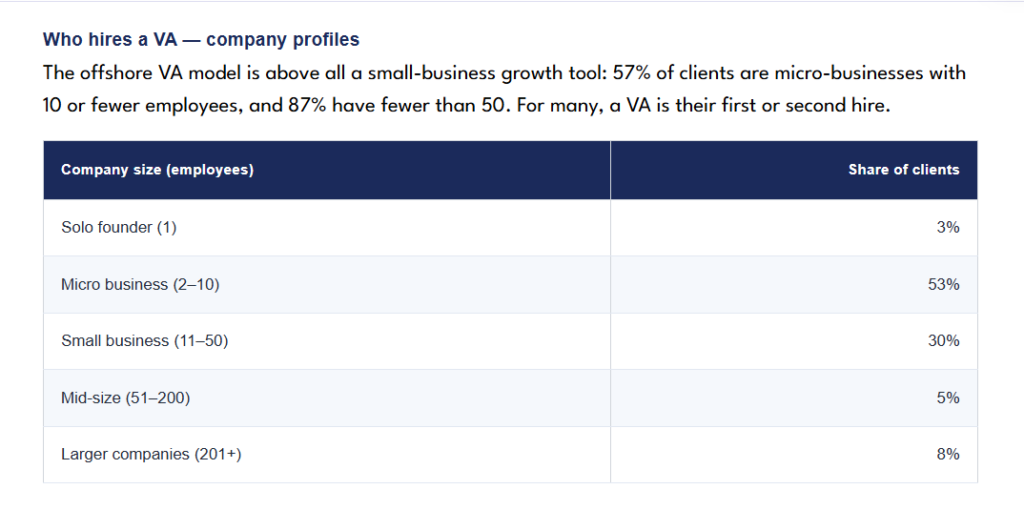
Small enterprises and early-stage companies form the core of direct offshore hiring, shifting away from standard corporate call center models. Businesses with fewer than 50 employees represent 87% of all client placements. In detail, micro-businesses with two to 10 employees account for 53% of total demand, while small businesses with 11 to 50 team members make up 30%. Solo founders account for 3%, mid-size companies with 51 to 200 staff represent 5% and larger enterprises of over 201 employees comprise the remaining 8%.
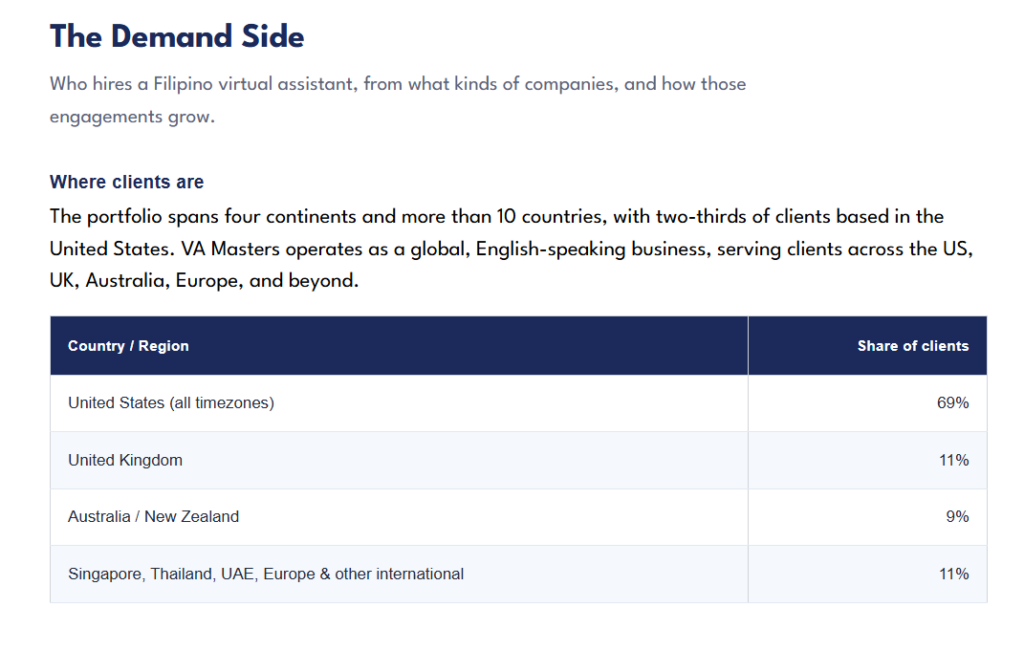
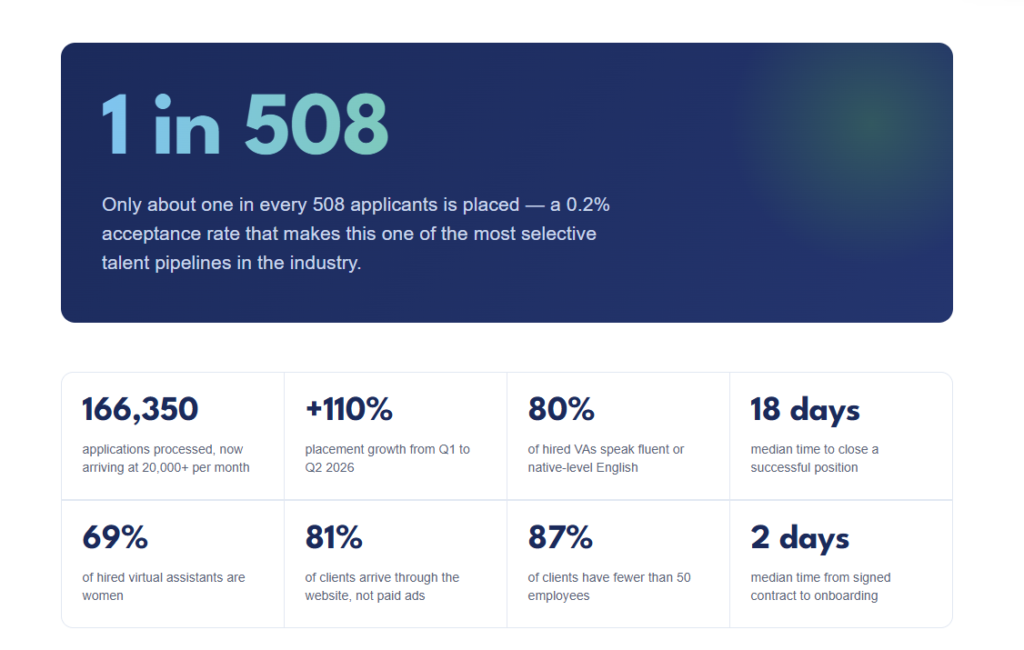
Client adoption accelerated substantially with a 110% increase in signups between the first and second quarters of 2026. This influx is driven organically, with 81% of new clients joining via direct web discovery rather than outbound sales pitches, followed by 8% through referrals and 5% through paid advertising. The geographic footprint remains led by the United States at 69% of active contracts, followed by the United Kingdom at 11%, Australia and New Zealand at 9% and other English-speaking hubs at 11%.
Female Professionals Lead Sector Demographics
The industry data confirms that women represent the majority of the remote talent pipeline across all evaluation tiers. Women account for 61.5% of total applicants and convert at higher rates through technical skill assessments, representing 69% of placed virtual assistants worldwide. The median age across the talent pool is 28 years.
Rigorous evaluation standards lift placement qualifications well above baseline applicant averages. While 62% of the general applicant pool demonstrates fluent or native English proficiency, that figure rises to 80% among hired talent. Similarly, candidates with three or more years of specialized domain experience make up 36% of the general pool but represent 65% of successful hires. The pipeline operates with notable speed, as 55% of applicants complete technical evaluations within 24 hours of submission.
Strict Vetting and Direct Software Integration
With more than 20,000 monthly applications submitted at a rate of one every two minutes, screening standards place just 0.2% of applicants, which equals 1 in every 508 candidates. This direct model contrasts sharply with traditional BPO frameworks that rely on mass-volume seat-filling and isolated external teams separated by management layers.
Direct placement embeds professionals straight into company software such as Slack and HubSpot while slashing overhead costs by up to 80%. Hiring timelines also accelerate under this model, taking an average of 18 days with 42% of roles filled in under two weeks and onboarded in just 48 hours, compared to the four to eight weeks typically required by legacy providers.
Rise of Fractional and Part-Time Workflows
To manage operational expenses without taking on financial strain, 64% of companies adopt fractional or part-time structures rather than immediate full-time commitments. An entry allocation of 80 hours per month, representing a half-time setup, is the most popular choice among founders and accounts for 41% of initial placements.
Full-time roles of 160 hours per month represent 20% of contracts, while light part-time schedules of 40 to 60 hours make up 14%. The remaining placements consist of 120 or more hours per month at 11%, 100 hours per month at 10% and custom scheduling structures at 4%.
“Traditional BPOs were built for repetitive tasks managed through middle management layers that separate the client from the worker,” said Alon Pearl, Founder and CEO of VA Masters.
“Everyone talks about the Philippines as a source of affordable labor, but the story here is selectivity. Business owners want dedicated team members who understand their brand, work directly in their company software and execute high-level work.”
Direct placements deliver strong operational stability over time. Fewer than 4% of client partnerships end due to performance dissatisfaction. Additionally, 1 in 5 clients expand their remote workforce by hiring more virtual assistants following their initial placement, solidifying the model as a lasting alternative to legacy outsourcing.